Skyliners, Art Deco For Your Hand

22 11 2009

I’m cheating with this post. None of the following is my work. I found this article by Jim Mamoulides and I thought it was fantastic! Here it is:


Eversharp Skyliner is Unveiled

In 1940, the Wahl company reorganized under the Eversharp name, which was better known in the marketplace because of the continued success of the Eversharp pencil line. The Eversharp repeater pencil, introduced in 1936, was really driving sales and profits for the company, which had fallen far behind Sheaffer and Parker in total sales revenue.


Eversharp Skyline Presentation Brown With Gold Filled Radial Engraved Cap c1943-1948
On Photo of 20th Century Limited

A new line was needed to spur sales and regain market share. Eversharp engaged industrial designer Henry Dreyfuss (1904-1972) in 1940 to design a new line of pens and pencils. This new line would take advantage of Eversharp’s repeater pencil success and its reputation for making high quality nibs, but would be a move away from the Art Deco influenced designs and gimmicky features introduced by Wahl Eversharp in the late 1930s. .


Eversharp Skyline Standard Size in Gray Modern Stripe c1943-1948

The line was unveiled in the spring of 1941 as the Skyliner and supported by a heavy advertising campaign. The name evoked the excitement of air travel and early advertisements proclaimed “Magic Feed prevents ink flooding or leaking high in a plane…so of course at ground level, too.” Eversharp quickly shortened the name to Skyline, probably within the first year. Interestingly, Eversharp returned to the Skyliner name in advertisements by 1946 and appeared to use that name until the line was retired.

The Skyline pen is a conventional lever filler with a radical streamlined design, a Dreyfuss hallmark. Some have noted that the pen shows strong influences from the Dreyfuss designed New York Central 20th Century Limited streamline locomotive. Several have pointed out that the pen, when viewed top down, has the same dome shape as the front of the locomotive and tapers off as the train would into the distance. The clip favors the smoke blowing from the smokestack to the back of the train.

The design looks very top heavy capped, especially on the smallest models, but becomes very balanced posted. The nibs have the typical very smooth writing qualities expected from earlier Wahl Eversharps. Though available in a wide range of styles and flexibility, they generally aren’t marked with size or flexibility. The over the top clip design made the pen eligible for sale to the military, as it sits quite low in the pocket. The earliest Skylines have visulated sections.


Eversharp Skyline Demi Size in Brown Modern Stripe c1943-1948

Dreyfuss also designed the rotary telephone in 1937. It is said that the taper tip of the pen is designed to double as a phone dialer. Some references say the pen was shown in the Museum of Modern Art in New York as part of an industrial design exhibit.

The Skyline was a huge success for Eversharp, eventually becoming, by 1945, the best selling pen in the USA. Skylines faded from Eversharp advertising after 1945 in favor of other models such as the Fifth Avenue, but was produced until 1948, when the Symphony was introduced.

Skyline Models


Eversharp Skylines c1943-1948 – Top to Bottom, Capped:
Modern Stripe Standard Gray / Demi Brown / Presentation Brown With Gold Filled Radial Stripe Cap

Skylines were produced in a broad variety of colors and cap types. It’s almost as varied as Parker Vacumatic typing. The earliest Skylines, probably the first one or two years, have a black visulated section and an ink drain, rather than the later breather tube. The breather tube was a big improvement in maintaining even pressure balance inside the pen to prevent leaking. Later Skylines usually have a section that matches the barrel color.


Eversharp Skylines c1943-1948 – Top to Bottom, Posted:
Modern Stripe Standard Gray / Demi Brown / Brown With Presentation Gold Filled Radial Stripe Cap

Three pen sizes were made, Demi or Lady, Standard, and Executive, which are about 4 3/4 inches, 5 1/4 inches, and 5 1/2 inches long, respectively. The caps on the two smaller models are threaded the same and can interchange, which can create new “models” and variations. The Executive model is actually very uncommon and will command a high price from collectors. All models had matching repeater pencils. The pens sold in a wide price range, from low-cost all-plastic pens to all solid 14 karat gold models: pens from US $3.50 to $125.00, pencils from US $1.50 to $75.00, and pen and pencil sets from US $5.00 to $200.00. An ill-fated ballpoint, the CA (for “Capillary Action”) was also made.


Eversharp Skyline In Three Sizes
Left to Right: Standard / Executive / Demi

The double check mark on the clip indicated the pen carried the Eversharp lifetime warranty.

A general reference of model types follows, but by no means is it definitive. There are probably more variations:


Eversharp Skyline Gray c1943-1948 and 1944 Advertisement Showing Striped Celluloid Cap Pen Set

All Solid Color Plastic Cap and Barrel: These were the cheapest Skylines and are solid color pens in with the cap and barrel in all black, green, navy blue, brown, dubonnet (burgundy), or silver gray plastic. The cap may be smooth or have radial engraved lines. The derby is plastic and matches the body color. Trim may include a thin or wide cap band. Wide cap band pens are the least common. All solid color pens came in all sizes, but the Executive size was made only in black. One version of the all-solid pen has the half or short clip, no cap band, and was the least expensive model. The clip on these pens stops at the derby, instead of going over the top. These low-end pens were made in the standard size only. Trim is gold filled. Early price sheets show solid color pens in both Men’s (standard) and Ladies (Demi) sizes at US $3.50 and matching pencils at US $1.50. Pen and pencil sets listed at US $5.00. By 1946, solid color pens were, in both Men’s (standard) and Ladies (Demi) sizes, US $5.00 and matching pencils at US $3.75. Pen and pencil sets listed at US $8.75.


Eversharp Skyline Modern Stripe Blue Repeater Pencil c1943-1948
Scan Courtesy Siegmund Stadtbäumer

Modern Stripe or “Moire”: Models with single color longitudinal striped caps and barrel in silver gray, green, blue, red and brown. The Modern Stripe pen came only in the two smaller sizes. The color stripes are wider than alternating black and have a radial grain. Three styles in order of price, lowest to highest: no cap band with derby cap matching body color, narrow gold filled cap band with derby cap matching body color, and wide gold filled cap band with gold filled derby cap. The plastic derby color matches the barrel color. Trim is gold filled. The Modern Stripe pens were also low price entry level pens. Early price sheets show solid color pens in both Men’s (standard) and Ladies (Demi) sizes at US $3.50 and matching pencils at US $1.50. Pen and pencil sets listed at US $5.00.


Eversharp Skyline Brown Pen and Navy Blue CA Ballpoint With Celluloid Caps c1943-1946

Striped Celluloid Cap: Models with longitudinal striped celluloid caps in all three pen sizes. The cap stripes are alternating color strips that are all the same width. The cap color and the derby match the barrels, which come in solid black, green, navy blue, brown, dubonnet (burgundy), and silver gray. Trim is gold filled. This is the only Skyline model that has problems with discoloration. Advertisements from 1943 show celluloid cap pens in both Men’s (standard) and Ladies (Demi) sizes at US $5.00 and matching pencils at US $3.75. Pen and pencil sets listed at US $5.00. By 1946, celluloid cap pens were, in both Men’s (standard) and Ladies (Demi) sizes, US $5.00 and matching pencils at US $3.75. Pen and pencil sets listed at US $8.75.


Eversharp Skyline Derby Detail

Presentation Gold-filled Cap: Caps have a gold filled overlay and have either radial (the most common pattern), or more rarely, longitudinal engraved lines. These pens are also known as “Presentation” models. These pens were made only in the standard and Ladies or Demi size. The derby is plastic and matches the barrels, which come in solid black, green, navy blue, brown, dubonnet (burgundy), and silver gray, or the derby is gold filled. Trim is gold filled. Early price sheets show Presentation pens in both Men’s (standard) and Ladies (Demi) sizes at US $8.75 and matching pencils at US $4.00. Pen and pencil sets listed at US $12.75. By 1942, the pen and pencil set was $14.75.


Eversharp Skyline Presentation Gold-Fill Longitudinal Line Cap Pattern Brown Barrel c1943-1948
Scan Courtesy Siegmund Stadtbäumer

Stainless Cap: Caps are all gold filled and have either radial, or more rarely, longitudinal engraved lines. No cap band. These pens were probably made only in the standard size, but mismatched Demi pens would be impossible to tell. The derby is plastic and matches the barrels, which come in solid black, green, navy blue, brown, dubonnet (burgundy), and silver gray or the derby is chrome plated. Trim is chrome plated. Stainless capped Skylines are very rare. Early price sheets show stainless cap pens in only the standard sizes at US $11.75 and matching pencils at US $2.00. Pen and pencil sets listed at US $13.75.

Sterling Cap: Caps are sterling silver and have either radial, or more rarely, longitudinal engraved lines. No cap band. These pens were probably made only in the standard size, but mismatched Demi pens would be impossible to tell. The derby is plastic and matches the barrels, which come in solid black, green, navy blue, brown, dubonnet (burgundy), and silver gray or the derby is chrome plated. Trim is chrome plated. Sterling capped Skylines are rare.

Vermeil Cap: Caps are sterling silver with gold plating and have either radial, or more rarely, longitudinal engraved lines. These pens were probably made only in the standard size, but mismatched Demi pens would be impossible to tell. The derby is plastic and matches the barrels, which come in solid black, green, navy blue, brown, dubonnet (burgundy), and silver gray or the derby is gold filled. Trim is gold filled. Vermeil capped Skylines are very rare.

Solid 14 Karat Gold Cap: Caps are solid 14 karat gold including the derby, and are plain or have either radial, or more rarely, longitudinal engraved lines. No cap band. These pens were probably made only in the standard and Demi size. The barrels come in solid black, green, navy blue, brown, dubonnet (burgundy), and silver gray. The pen and matching pencil set sold for US $64.00, priced promotionally with a popular radio quiz show, “The $64,000 Question”, and the pens were called “$64 Sets.”


Eversharp Skyline Gold Award All Gold-Fill Chevron Pattern c1943-1948
Scan Courtesy Siegmund Stadtbäumer

All Metal: Caps and barrels in gold-filled, sterling silver or vermeil. Numerous engraved or machined patterns, including radial lines, longitudinal lines, and chevrons, reminiscent of the machined pens of the 1920s, as well as plain (smooth). No cap band. Vermeil and gold-filled pens with radial engraved stripes were also known as “Gold Award” pens. All metal pens were probably only made in the Standard and Demi size. The derby and trim is gold filled or chrome plated to match the pen finish. All metal Skylines are uncommon. Early price sheets show 12K gold filled cap and barrel pens in only the standard sizes at US $13.75 and matching pencils at US $6.00. Pen and pencil sets listed at US $19.75. By 1942, the Gold Award pen and pencil set was advertised at $22.50.


Eversharp Skyline Gold Award c1941-1942

Command Performance: An all solid 14 karat gold cap and barrel model, advertised as “Command Performance” was also offered for US $75.00. This model was probably only made in the Standard size. Advertisements show a plain or smooth body pen and pencil, though it is possible that engraved or machined patterns were offered. Called the “gift of a lifetime” by Eversharp. Of the all metal Skylines, smooth 14 karat gold models are the most common, and generally are not considered rare. The matching solid 14 karat gold pencil was US $50.00 and the pen and pencil set was US $125.00.

Solid Platinum: An all solid platinum cap and barrel model is catalogued, offered for US $125.00. This model was probably only made in the Standard size. The matching solid 14 karat gold pencil was US $75.00 and the pen and pencil set was US $200.00.

Wahl Skylines: Some models will have the Wahl name engraved on the clip instead of Eversharp. These models are uncommon. It is believed that Wahl produced these pens to maintain the Wahl name as a trade name. There is no other difference between these pens and other Skylines.


Eversharp Skyline Nib and Cap Detail

Modern Reissues: In the 1990s (1992-1995) there was a series of reissued cartridge / converter Skylines. These included a chrome and gold plated cap model similar to the silver and gold radial engraved capped pens from the 1940s. There was also a “demonstrator” limited edition model, a “Yellow Cab” (in all yellow plastic) and “Fire Engine” (in all red plastic) model that came with a toy car or truck. A very expensive U. S. Army Air Corps Commemorative Limited Edition was released made from aluminum from World War II era fighter planes. The Eversharp company had long ceased to exist, so these models are more commemorative than authentic issues from the original company.


Eversharp Skyline All Gold Fill Chevron Cap Detail

Skylines are prized by many collectors and the many variations of the pen and the large production run has meant that many of the pens survive today. Unfortunately, Skylines are known to have problems with plastics shrinking and becoming brittle, making some pens risky to open to replace sacs, for fear that they will break. Some pens with plastic derbies have had problems where the derby has shrunk making the trim loose. Beware glued derbys. They were made to unscrew, and this method predicts later problems. The design makes posting the cap a constant wear on the lever, resulting in brassing. They don’t tend to have body cracks from posting, however, a testimony to the telephone dialer design.


Eversharp Skyline Gray Modern Stripe c1943-1948

Dating Skylines is probably a lost cause, unless you have a visulated section pen. Some of the very first pens had two tone nibs. Eversharp did not use date codes on the pen and the fact that there are so many variations really makes a specific year dating impractical.


Eversharp Skyline Nib and Feed Side by Side

Performance

Skylines are generally easy to find and haven’t gone through the outrageous price acceleration as other pen lines. I tested a Standard size gold cap Skyline with a brown plain barrel and Standard size gray Modern Stripe Skyline.

Both of the pens tested have very smooth and wet writing medium nibs. Being Standard size, both pens measure out at 5 1/4 inches long capped and post deeply and securely at 5 5/8 inches. These pens post well and have excellent balance. The military clip design makes the pen sit low and snug in the pocket.


Eversharp Skyline Presentation Brown Gold Filled Radial Engraved Cap c1943-1948

The pens fill easily with a single stroke of the lever and ink the paper immediately with a smooth wet line. The gold cap pen is a bit pedestrian looking next to the Modern Stripe, which to me is a wonderful plastic. The detailing on both is excellent, as these were both found as problem-free pens. In daily use, these are great writers and should make anyone’s rotation if usability is the criteria.

Skyline variations abound, but certain models are going to attract the most attention and money. The Modern Stripe pen is very uncommon, sought after by collectors, and commands a relatively high price. On the other hand, the solid gold and gold filled pens generally go for less than comparable models of other brands made from the same materials. Beware dings in all-metal pens. A pricey pen will be the stainless cap model. Very rare.

Collecting Skylines should be rewarding. There are a lot of them out there and a decent and varied collection can be had for less than some other, more popular pens.


Pen Photography to Pass The Time

8 11 2009

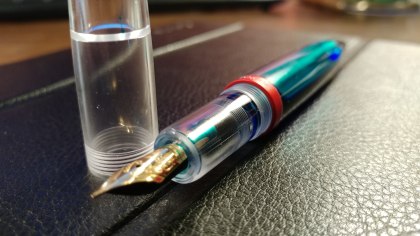
I’ve really been lousy about updating this blog and giving anybody any reason to look at it.  So in an effort to try and do better, I thought I’d just post some pictures of my favorite pens just for the sake of ‘pen photography’. Please feel free to ask questions or leave comments.

Figure 1 Blue Water Phileas Nib in Fine Point

This is one of those pens I’d want to have with me if I could only pick a few to be stranded on a deserted island with.

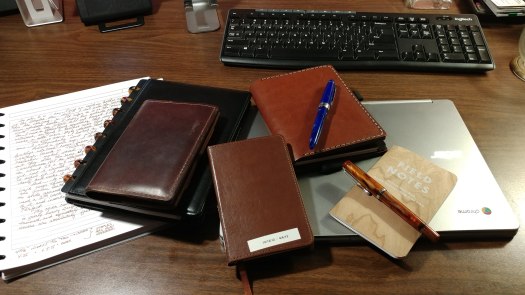
Figure 2 A Gathering

This is a typical meeting of the local pen union’s 101 monthly meeting. This was just prior to a strike instigated by the Parkers whereby all of their bladders dried up and deteriorated away.

The Old Man of my collection.

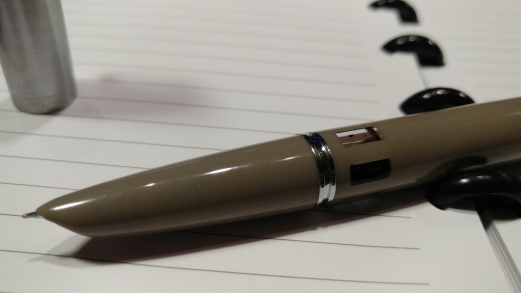
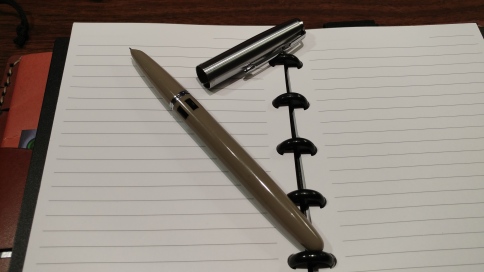
Figure 3 The Asian contingency, a Hero 51 Clone

Don’t let anyone tell you different. These are NICE pens! Incredible value considering the $$! A Hero 616.


Levenger True Writer

31 08 2009

Once again, it’s been a while since I did an update here. Hopefully I can get back in the habit and change that. One big reason for my lack of posts has been the economy. It blows, by the way, in case you might be wondering. Blows I said…

Back in February I was laid off from a position I had with a local developer as a project manager. Here’s how bad this economy blows. Last December, we won an RFP (Request for Proposal) to do a redevelopment project for the local university. This would have been a $200 to $225 MILLION dollar (…that was MILLION with an M) project. Good news right? Job security for the next 5 to 7 years, minimum. Oh, and a BIG raise to come (lots of pens to buy…). This was December of ‘08. By February 2009, you couldn’t find financing for a project like this anywhere. And so, the lay-offs began.

I relay this story not to solicit sympathy. No. Lots of folks have had it worse, and gone through much worse than me. I’m now entering into a new career (Insurance agent with Colonial Life) and finally feel like I can begin to allow at least a little time for some of my previous hobbies again.

Tonight I decided to break out an old favorite of mine, a cobalt blue, Levenger True Writer, circa about 1995.

I have two of these pens, this one, and a stunning (I think…) white pearl version, both with fine points. First, the physical description. This pen as mentioned is kind of a pearlized cobalt blue color with chrome hardware. By Levenger’s own account, these pens were modeled after one of my favorite pen lines, the wonderful Esterbrook J series pens. That heritage is easy to see. The cap is topped off with a simple black tassie mounted over a chromed clip. A chrome band sits just above the cap lip, and has the company name LEVENGER elegantly engraved on it. Like the Esterbrook, the Levenger sports a screw-in stainless nib. The nib is quite elegant, I think. It sports only a slit for the tines, no breather hole, like traditional nibs. Unlike the Esterbrook, this pen has a section that is the same material and color as the rest of the pen’s body. The Esterbrook sported a black section. The end of the pen features a chrome ring and another black tassie matching the one on the cap, simply smaller. Compared to the Esties, this is a substantially larger pen, measuring 5 3/8 inches long capped and 6 ½ inches long posted. From a strictly aesthetic point of view, I’ve always thought this was just a stunning pen.

Although I do love this pen, both it and its white sister-pen have had some quality problems. The chrome band on this one has come loose several times. I’ve repaired it with some crazy glue and for now, it seems to be holding; though it also sits a bit lower on the cap than it originally did. The white one I have had a problem with the section, where the nib screws in. It basically disintegrated around the nib. A call to Levenger got me a new nib and section for $25. (Does anyone still sell a reasonably priced pen with a lifetime warranty anymore?)

My True Writers are both outfitted with converter, but will also accept universal style cartridges. These pens are the definition of a “buttery smooth writer”. Like butta. Like butta, I tell you. Both of my pens are fine points, but definitely write closer to a medium point as compared to most of my other pens. I know that my pens are some of the early ones produced by Levenger, though I don’t know if they’d be considered 1st generation or not. I mention this, primarily because I’ve read that many of the early pens suffered from quality problems such as those I mentioned earlier. It’s my understanding from several online sources (Fountain Pen Network among others) that the current line of True Writers from Levenger are largely problem free.

This is not a pen that you see a lot of information about. Anybody reading this that knows more about them (I certainly don’t claim to…) please add a post to tell us more about these great pens!


Waterman’s Phileas

4 06 2009

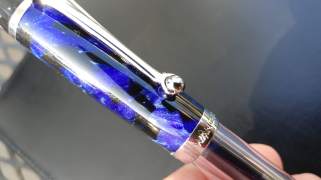
It’s been too long since I’ve written anything here, so I need to get back in the game. I broke out another of my “starter” pens the other day, a Waterman Phileas in blue marble finish.

This really is a fantastic pen! It’s also (I think) very under-rated. You just don’t see a lot written about it, though what you do find, is generally very positive. I got this pen about 12 years ago, and it’s seen a lot of use in my rotations.

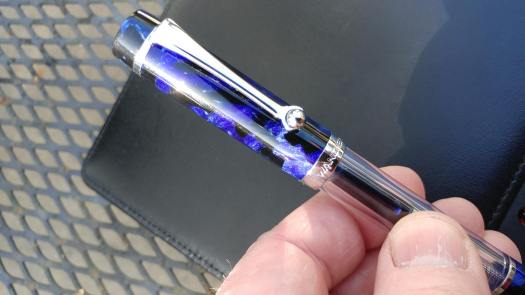
Figure 1- It sticks out in the crowd

My first impression of this pen is that it’s strikingly handsome……Until you look closely. Not that it’s ugly at all (I just said it was handsome), but there are some things about it that make it look a bit cheap in my opinion. First, the pen sports a gold ‘cigar band’ close to the posting end of the pen, that’s been crimped on. It’s not a solid band, if it were, it would make a lot of difference in it’s looks. Second the blue marbling effect looks better from a distance than up close. To me, it’s just a bit cheesey looking. But make no mistake, this is NOT a cheap pen. The quality is extremely good.

Figure 2 – Phileas Nib

The nib is a beautiful two-tone stainless number, mine, in a fine point. And it really is a fine point. A lot of modern pens with a nib labeled ‘fine’ tend to be more towards the medium end of the spectrum. I’ve run all kinds of inks through this pen, and no matter how long it’s been sitting capped, it always starts an immediate fine, wet line. Again, my experience has been that many fine-pointed nibs will tend to have some slight problems getting started after long periods of not being used.

When I acquired my pen years ago, I think I paid about $45; Fountain Pen Hospital has them for $55. A great deal for a pen of this caliber.

Figure 4 – Cigar Band, Looks good from the front